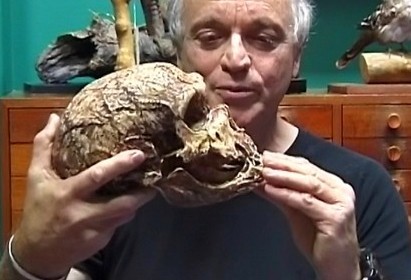
 Since Charles Darwin and Alfred Wallace discovered natural selection in 1858, it’s been assumed it is the only evolutionary process operating on planet Earth, responsible for the evolution of both physical and behavioral traits. Now in his latest book, theoretical biologist, Danny Vendramini challenges that view, arguing that a second evolutionary process emerged 543 million years ago to regulate the evolution of innate behavior, instincts and emotions in multicellular animals.
This site describes Vendramini’s groundbreaking theory and his new book, The Second Evolution: The secret role of emotion in evolution.
Although arguably the most revolutionary idea in biology since Darwin, Vendramini’s theory is based on the simple premise that everything in nature evolves, including evolution itself.
Read a non-technical introduction to teem theory by the author here.
 Danny Vendramini’s paper on Teem Theory
For the more academically minded, there’s also Danny Vendramini’s historic 2005 paper on teem theory. Published in the British journal, Medical Hypotheses, the paper is the first unified theory of evolution, inheritance and behavior published in a peer reviewed scientific journal since Darwin and Wallace’s historic 1858 papers on natural selection.
Citation: Vendramini, Danny. (2005) ‘Noncoding DNA and the teem theory of inheritance, emotions and innate behaviour’. Medical Hypotheses. v64, 3, pp512-519. doi:10.1016/j.mehy.2004.08.022.
The Preface to The Second Evolution
If reading dry academic papers is not your thing, read the Preface from Danny’s book, The Second Evolution: How emotion drives evolution. It gives a tantalizing overview of his theory and how the book came about.

What scientists say at teem theory
My reaction: your approach makes very good sense because the ability of Homo sapiens to adapt to widely different environments (obviously a key feature of the species) will be greatly enhanced through the ability to shape somewhat the triggers of emotional responses in the manner you describe.’
Professor Roger Masters. President, Foundation for Neuroscience & Society
‘I think TEEM theory is all very scientifically addressable, and can rely on standard genetic techniques.’
Professor David Featherstone, Department of Biological Sciences. University of Illinois at Chicago
‘I think you make splendid arguments regarding the necessity for a system of inheritance other than Darwinism.’
Dr. Mary MacGibbon, ACU, Australia
‘If you are right, nearly everything I know about genetics and development is wrong.’
Robert Trivers, Professor of Anthropology and Biological Sciences, Rutgers University
‘I will certainly look forward to seeing the publication of your book, not least because of some recently developed interests of my own on the evolution (and inevitability) of sensory mechanisms.’
Professor Simon Conway Morris. Cambridge University
‘I taught Darwin and biology for more years than I care to remember. I am retired now but still like to keep up with what’s new. I read your book extract with great interest, thanks for putting it online. It’s a real achievement, up there with the best science I’ve come across.’
Wiliam Novak
‘Your proposal that two evolutionary mechanisms administrate evolution is so very simple but equally very profound. It brought to mind Thomas Huxley’s remark when he was reading Charles Darwin’s book, The Origin of Species, “How incredibly stupid not to have thought of that myself.’
Dr. J. Dayal Purohit
‘Some of your ideas parallel those of researchers who believe that there are very large portions of the genome dedicated to producing non-coding [regulatory] DNAs. Unfortunately, the evidence for this is yet to arrive, although a small number of microRNA genes is known.’
Professor Ross H Crozier. James Cook University, Australia
 ‘I believe that his propositions for the function of “junk DNA” are very plausible. He has supported his propositions and conclusions by a wealth of scientific published evidence.. the publication of the theory itself would be a very worthwhile addition to our understanding of this area of human and animal biology.’
Professor Tord Kjellstrom. ANU, Australia
‘Your theory is very novel and interesting.’
Professor Kirk Winemiller, Texas A&M University
‘As I read your website, it provides an explanation for thoughts that have puzzled me for decades. The possibility of an “emotional genetic inheritance” explains how information is passed down generations whereas natural selection would take too long a time to adapt.’
Alan Wolliner, New York
‘teem theory is potentially an alternative explanation for the evolution of behaviour, not the sole available explanation. This raises the bar a bit, and means that you must show why your explanation is more plausible and more powerful than the alternatives. If you can do that, it will be a very important contribution.’
Russell Bonduriansky, Associate Professor, Evolution & Ecology Research Centre and School of BEES. University of New South Wales, Sydney NSW Australia
Check out more feedback and comments, mainly from academics here.
D oes this mean Darwin was wrong?
Evolution undoubtedly occurs by natural selection and Darwin’s theory explains incremental gradual evolution (what we call microevolution) perfectly well. The problem is that it’s less adept at explaining the big ticket items – what we call macroevolution (morphological complexity, biodiversity, speciation etc.) and unable to adequately explain behavioral evolution.
Teem theory doesn’t refute Darwinism, it simply adds a new complementary strand to Darwin’s theory. By filling in a few blanks and resolving a number of long-standing biological, paleontological and genetic problems, teem theory can only strengthen our existing NeoDarwinian paradigm.
Buy the ebook
Judge for yourself. Is The Second Evolution the twenty-first century sequel to The Origin of Species?
The Second Evolution Ebook is available on Amazon. The Kindle price is USD $9.18

By the same author
 ‘Them and Us: How Neanderthal predation created modern humans’
 A scientific theory is like a key. If it’s correct, it can unlock all sorts of other doors. Vendramini used teem theory to examine the mystery of human evolution – how, why, when and where we became human.
By analyzing innate behaviors and instincts in modern humans (what we affectionately call ‘human nature’) and analyzing the teems that encoded them, Vendramini came to the conclusion that our Palaeolithic ancestors had been hunted, cannibalized and raped by Eurasian Neanderthals in the Middle East for over 50,000 years.
The book is called ‘Them and Us; how Neanderthal predation created modern humans’ and it’s available as a paperback and Ebook from Kardoorair Press. Check out the website
You can also watch Danny’s video, on Youtube: Neanderthal: Profile of a super predator